PHASE ONE
Critical Response Projects
In Phase One, we are exclusively focused on two vital efforts: helping to stabilize our neighbors who are at the highest risk of displacement via a first-in-the-nation direct cash assistance program, and moving with urgency to acquire and build a bungalow court pilot project of four homes that will serve as proof of concept for how we begin to replace Altadena’s lost stock of naturally-occurring affordable housing that was home to 10,000+ renters and tenants who currently have limited or no pathways back.
CRITICAL RESPONSE PROJECT | PHASE ONE
Direct Cash Assistance for Altadena Recovery
In partnership with NCJWLA, the Altadena Tenants Union, and nearly a dozen other community partners, ACLT are joining to launch a first-of-its kind, long-term direct cash assistance program to support our neighbors.
What we hear consistently is that the greatest and most pressing need for families navigating this recovery is, simply, money. This program provides meaningful, sustained support to vulnerable renter households on a monthly basis for two years, with no restrictions on use of funds. In addition to financial assistance, participants will have access to optional wrap-around supportive services from our program partners aimed at strengthening long-term recovery.
-
To be eligible for the program, you must meet all the following eligibility requirements:
Have been a tenant in Altadena on January 7, 2025
Currently residing in Los Angeles County, Riverside County, or San Bernardino County
Have a combined household income less than or equal to HUD’s low-income threshold in your county (view HUD guidelines for your county here: Los Angeles County, Riverside County, San Bernardino County)
Be a single parent, head of household, or primary adult earner, primarily responsible for supporting dependents of any age
-
Renters and tenants accounted for more than a quarter of Altadena’s 43,000 residents.
Altadena’s renter and tenant households were stable and deeply tied to the community: 90% had 5+ years of residence in Altadena, and approximately two-thirds of had moved into their units before 2018.
Established disaster recovery resources and models are designed around and focused on homeowners, with little to no protections, assistance, or support directed at the more vulnerable population of renters and tenants.
Renters and tenants came into the fire with fewer economic resources, higher housing-cost burdens, and minimal or no insurance coverage.
Before the Eaton Fire, the median household income for tenant households in Altadena was about $73,000, which is only 48% of the median income for homeowner households ($150,000) and well below the overall Altadena median household income ($129,000).
At least 13% of tenant households lived below the federal poverty line (vs just 3% of homeowner households).
More than half of tenant households, and 60% of Latino tenant households, were rent-burdened in 2023, paying more than 30% of their income towards housing costs.
Almost all renters in Altadena (91%) were uninsured or substantially underinsured.
-
Applications will open on May 11, 2026; in the weeks leading up, we will offer a variety of information sessions both virtually and in person, in both English and Spanish. For more information, and to bookmark the application page, please click here.
-
We believe that dignity and autonomy for survivors is an essential component of a successful and equitable recovery. The direct cash model prioritizes agency and dignity, allowing survivor households to use cash for whatever they deem necessary, without restriction.
Previous direct cash programs tell us that money is primarily spent on housing, childcare, transportation, food, and medical care; we believe that survivor households need the ability and flexibility to make their own choices, and the resources to support their recovery.
Cash, coupled with supportive services, will provide survivors with dignity, agency, and autonomy — essential components of a successful and equitable recovery.
Direct Cash for Altadena Fire Recovery program prioritizes long-lasting, supportive recovery via a 24-month infusion of unrestricted cash. Over a two year period, survivors will receive a total of $36,000 (six months at $2000/month, 12 months at $1500/month, and six months at $1000/month) plus access to a large suite of wraparound supportive services provided by program partners.
-
Direct Cash for Altadena Fire Recovery has the potential to provide a new blueprint for long-term disaster recovery. Our partnership with the University of Pennsylvania’s Center for Guaranteed Income Research will support impact measurement and real-time data to help shape future disaster responses.
Direct Cash for Altadena Fire Recovery is survivor-led and addresses the lived experiences of impacted Altadena residents, with lead on-the-ground partners in the Altadena Tenants Union and the Altadena Community Land Trust, both comprised of 100% Altadena residents and fire survivors.
Recovery from the wildfires will take decades. We are still in the early stages. An infusion of long-term, unrestricted financial support in the recovery process could determine return to the region or the loss of the vibrant, diverse community that shaped the beauty of Altadena.
-
“Rebuilding for Whom? An Analysis of Tenant Demographics, the Rental Market, Affordability, and the Rebuilding Efforts in Altadena,” (Carmona et al., UCLA Latino Policy & Politics Institute): Building on prior disaster research, it provides a data-driven picture of how tenants have been affected and how they are faring in Altadena’s recovery. The brief draws on Census data, rental listings, fire damage assessments, construction permits, and property sales to examine how the rental market functioned before the fire and how it is changing in the aftermath.
Guaranteed Income Pilots Dashboard: The Stanford Basic Income Lab and Center for Guaranteed Income Research have partnered to visualize data from evaluations of 30+ guaranteed income pilots across the United States.
Visualizing Basic Income Research: The Basic Income Research Visualization bolsters basic income research by presenting existing knowledge in an accessible platform organized across multiple themes and subthemes. The visualization presents comprehensive summaries of articles, research papers, and books produced on basic income; enables viewers to see the diversity of approaches that have been taken on testing UBI, guaranteed income, and related policies; and allows users to get a good sense of the key tenets of the debate.
“Guaranteed Income In The Wild: Summarizing Evidence From Pilot Studies and Implications for Policy” (Jack Landry, Jain Family Institute): A survey of multiple basic income pilot projects from across the US, confirming that direct cash assistance is a powerful model for economic recovery at the household level, and investigating the data to see whether common myths and concerns about direct assistance models hold up to scrutiny.



CRITICAL RESPONSE PROJECT | PHASE ONE
Bungalow Court Pilot Project
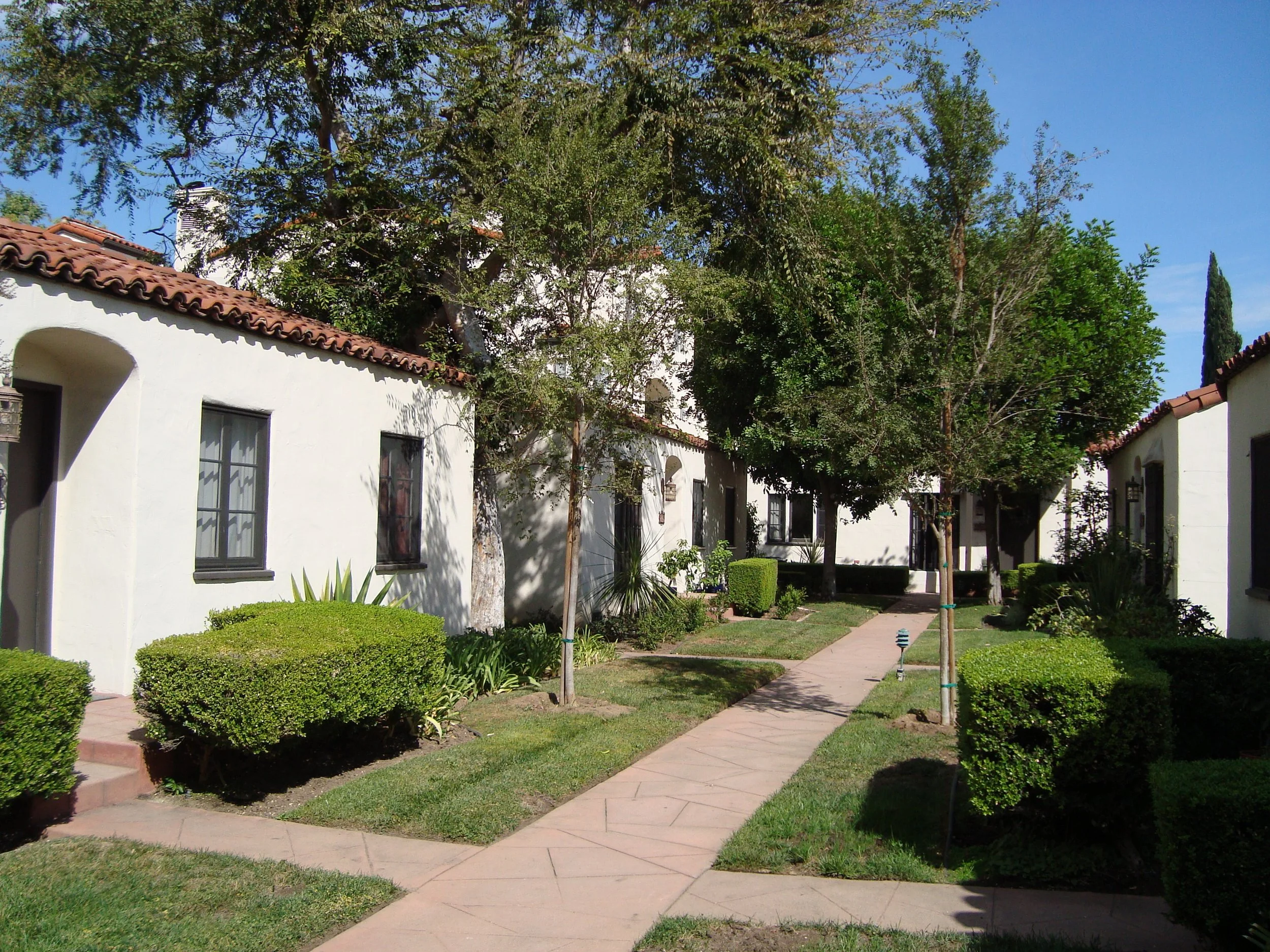
The bungalow court is a form of housing that has long existed in Altadena and Pasadena, and replacing it allows renters, fixed-income seniors, and other displaced Altadenans the opportunity to return to affordable regionally and culturally appropriate housing.
We will utilize this pilot project as proof of concept to seek additional funding and replicate this kind of gentle density rental housing replacement effort on other similar, appropriately-sized and situated larger parcels in Altadena in collaboration with our neighbors and community members.
We know that ultimately, some parcels will transfer ownership regardless of homeowner assistance. Without explicit intervention, these properties are likely to be redeveloped at price points only affordable to high income/wealthy households.
ACLT will selectively acquire burned or at-risk parcels for community-oriented redevelopment. Depending on neighborhood context and zoning, this may include:
Bungalow courts (2–4 units or clustered small-scale development in a gentle density model that reproduces forms of housing present in Altadena pre-fire and does not overburden community infrastructure)
Ground lease homeownership models
Small-scale multi-unit infill appropriate to the block
Homes developed through this strategy will be sold as improvements under a long-term ground lease, with resale formulas tied to incomes rather than market appreciation. This approach ensures that redevelopment activity contributes to durable affordability rather than displacement.
(Pictured: the Don Carlos Bungalow Court in Pasadena, built in 1927 on S. Marengo Ave.)